
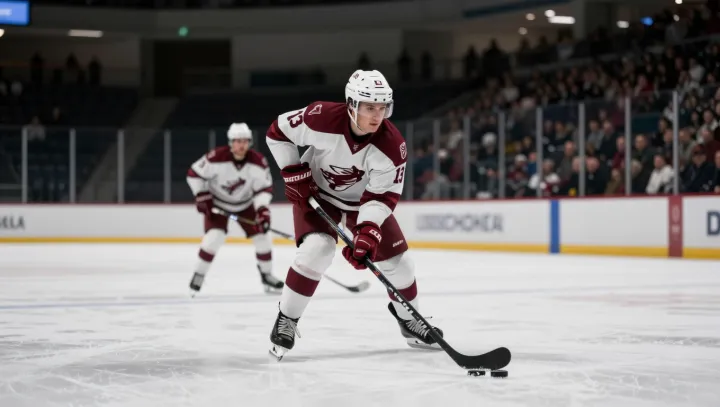
Cold black rubber, not the skater, dictates the true violence of elite ice hockey. A frozen puck, about six ounces, is routinely driven past eighty or ninety miles per hour, matching professional fastballs, sometimes surpassing them, while its launch platform is a blade gliding over low-friction ice instead of cleats dug into dirt.
This is not just strength; it is engineered transfer of momentum. Players rotate through the kinetic chain of hips, torso, and shoulders, converting angular momentum into linear velocity at the stick blade, where composite flex and the coefficient of restitution between stick and vulcanized rubber amplify speed. All of it happens while the skater counteracts reduced friction underfoot through precise edge control and constant micro-adjustments of center of mass, keeping balance as force vectors explode outward from a moving base.
The wilder claim is that this ballistic act is the easy part. Around the shooter, the rink behaves as a shifting three-dimensional grid of sightlines, passing lanes, and defensive gaps, forcing rapid visual processing and decision-making under cognitive load. Players choose shot angle, elevation, and release timing within fractions of a second, integrating game theory and spatial awareness while bodies collide and sticks slash at the puck. In that instant, a simple piece of rubber becomes the fastest argument on the ice.