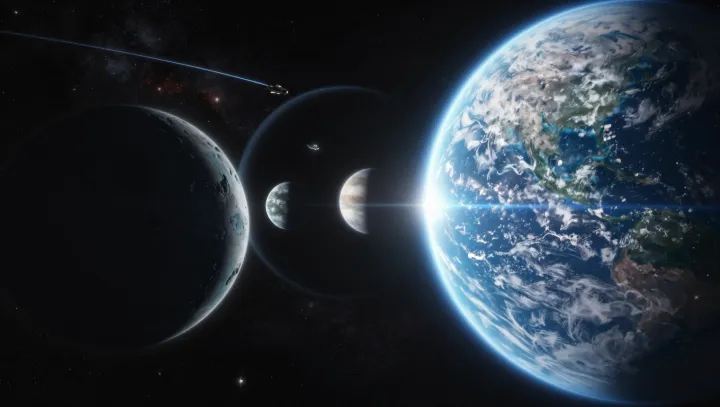
Liquid water, it turns out, is a low bar. Around the Sun, orbital real estate from Venus out toward the icy moons could, under the right atmospheric pressure, keep oceans from freezing or boiling, yet only one world carries radio traffic and orbiting hardware. The surprise is not that Mars or Europa look quiet today; the surprise is that Earth ever escaped that default.
The harsher claim from many astrobiologists is that technological intelligence is a late, fragile by‑product, not evolution’s standard outcome, and Earth’s history backs that view with long stretches of microbial dominance and repeated mass extinction. Plate tectonics, a strong magnetic field and long‑term carbon–silicate cycling kept surface temperatures and ocean chemistry in a narrow band for astonishing spans, while tidal locking, runaway greenhouse effects or atmospheric loss likely pushed sibling worlds off that tightrope. Under those stable conditions, natural selection had time to stack improbable steps: eukaryotic cells, complex multicellularity, nervous systems with high synaptic plasticity and, eventually, brains able to encode culture outside the skull through language and writing.
The sharper question is why intelligence that builds tools, rather than just solves local problems, ever paid off. Once hominin brains crossed a certain threshold of cortical integration and social learning, culture began to act like a second evolutionary algorithm, accelerating feedback between technology and environment and rewarding abstract planning, mathematics and symbolic thought. On other habitable worlds in the same zone, life may have stalled at bacteria, or forests, or even animals with rich cognition yet no cultural ratchet, leaving Earth as a statistical outlier in a region that, on paper, looks generous but in practice may be brutally selective.