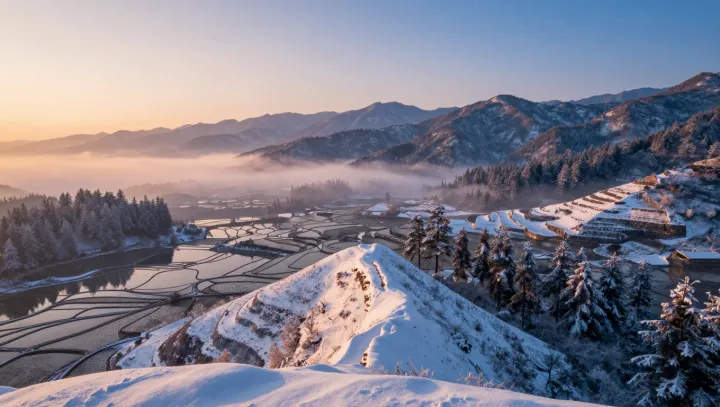
Not the sun, but the snow, decides how the valley wakes. Across terraced fields, a thin, uneven skin of crystals turns into an improvised optical device, redistributing the first weak rays of sunrise across slopes that would otherwise stay dim for much longer.
Counterintuitive is the fact that only a few centimeters are enough. Fresh snow has high albedo and a micro-rough surface, so each grain both reflects and refracts light according to geometric optics while still allowing partial absorption. On stepped fields, every terrace forms a slightly tilted plane, changing the incidence angle and bouncing low-angle solar radiation outward rather than straight back toward the sky.
More striking is how this system edits color. As light threads through the moist morning air, Rayleigh scattering and Mie scattering strip out much of the blue, leaving a spectrum richer in reds and oranges. The snowpack then behaves like an array of selective reflectors: ice crystals scatter shorter wavelengths deeper into the granular layer, where they are more readily absorbed, while longer wavelengths escape, reinforcing the warm tint that slips through the valley mist like a slow, rising blaze.