
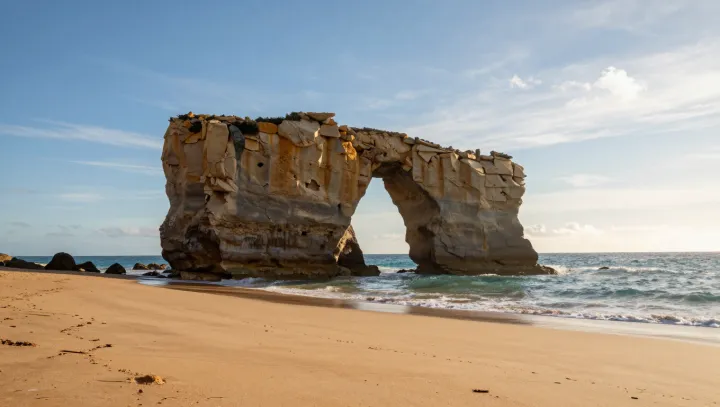
That rock arch is not a miracle of chance; it is a slow, strict audit of physics. At the core is a mismatch: air and water move with chaotic turbulence, yet the rock holds crystalline order, with joints, bedding planes and mineral boundaries that act like a pre-printed grid. Where stress concentrates along these structural weaknesses, abrasion and hydraulic pressure find ready purchase, so randomness meets a template and begins to behave like intent.
More selective than they look, wind and waves attack only where resistance drops. Grain by grain. Blow by blow. Fluid shear stress rises on protruding edges, while cavities trap vortices that ratchet up pressure during every impact, a process geophysicists frame through boundary-layer theory and fatigue fracture mechanics. Once a notch forms, wave refraction and airflow are funneled into it, amplifying local energy, so the arch enlarges itself by steering its own punishment.
The apparent precision is really ruthless editing. Softer beds are stripped first, leaving harder strata as ribs, columns and overhangs that outline the arch geometry. Cross-bedding, clast size and cement type remain in place as stratigraphic clues, allowing sedimentologists to back-calculate flow directions, storm intensity and exposure cycles recorded in the rock face. Page after page, the arch preserves each increment of loss as legible structure, a negative diary written by erosion itself.