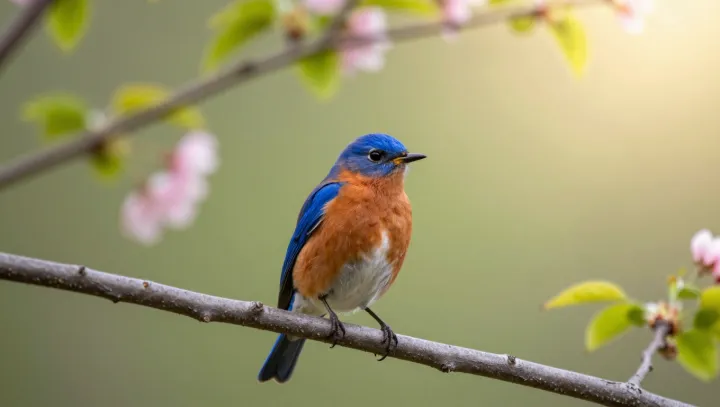
Light, not color, does the real work on a bluebird wing. In a still portrait, a narrow beam from one side carves bright bands along the coverts, while neighboring feathers fall into abrupt shadow; what looks like soft plumage instead behaves like a stack of tilted mirrors arranged along a curve.
More honest than any field guide is the way those bars shift when the camera angle moves a few degrees. Short stroke. The blue jumps, then fades, because keratin layers and air pockets inside each barb act as a photonic crystal, forcing certain wavelengths into constructive interference while others cancel out in destructive interference across the span.
The surprising part is that this quiet portrait functions as a geometry proof. First the wing edge traces a chord, then the overlapping feather vanes mark parallel lines, and the gradient of brightness records the incident angle of sunlight as cleanly as a protractor; to anyone willing to pause, the bird stands still while the math moves.