Violence builds order here. Along exposed coasts, wave energy behaves less like random chaos and more like a sorting machine that strips away weakness and promotes whatever can pass its test. Each breaking wave delivers hydraulic action and pressure shifts into joints and bedding planes, prying open tiny cracks and turning them into fractures that reorganize an entire headland.
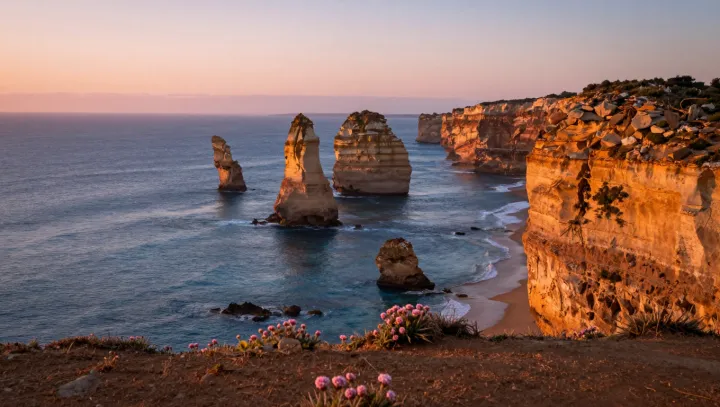
Paradox sits offshore. Those calm, solitary stacks began as parts of solid cliffs, but repeated cycles of compression and decompression, combined with abrasion by suspended sand and shingle, selectively attacked zones of softer or more fractured rock first. Caves opened. Arches formed. Collapse removed the bridge, yet left behind denser pillars where mineral cement, grain size and joint spacing gave the rock greater compressive strength than its surroundings.
Elegance lies in the brutality. As longshore currents sweep debris away, they prevent fallen blocks from armoring the base, so wave refraction keeps focusing energy on the projecting remnants, sharpening their profiles while slowly thinning their cores. What looks like stillness at sunset is only a pause in an ongoing mechanical experiment, with the next blow already on its way.