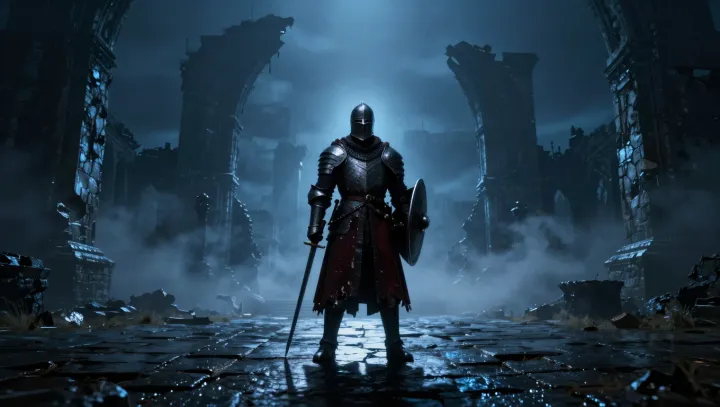
Cold backlight does more political work than the armor itself. By burning a halo around the helmet and shoulders, cinematographers erase facial scale cues, pushing the child’s proportions toward silhouette, where the brain stops measuring and starts mythologizing. With exposure riding the edge of clipping, the figure becomes a high‑contrast glyph while the world in front sinks into underexposed obscurity.
Fog, oddly, is the bully here. It flattens depth of field, turns distant walls into a blank diffusion panel, and gives that backlight something to carve, so the knight drags a column of light through the frame like a moving monument. Low angles then cheat physics: by placing the horizon below the waist and letting vertical lines converge upward, basic perspective projection inflates the body, legs and sword into architecture rather than anatomy.
Wet stone finishes the lie. Dark, glossy rock reflects that same cold source in broken streaks, creating specular highlights that echo the armor and extend the knight’s presence across the ground. Each footfall lands inside a cluster of reflections, which makes a short stride read as a heavy advance. What looks like a small performer in a rental breastplate becomes, through pure optics and geometry, a figure that feels almost too large for the frame.