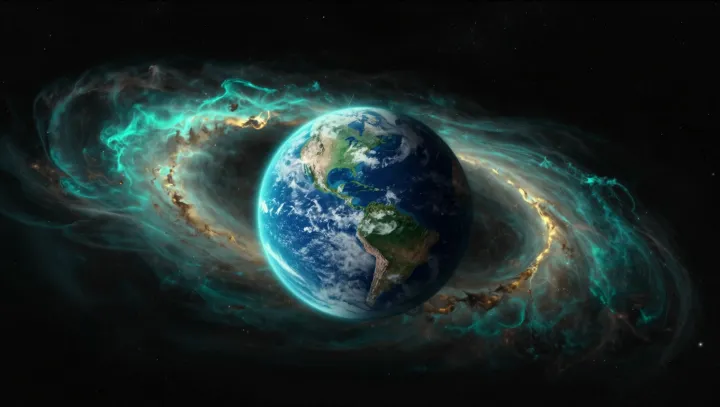
Sharp oceans on alien worlds are not evidence. They are a bet. Telescopes record exoplanets as single pixels or as faint dips in starlight, while spectrographs tease out absorption lines that hint at water vapor, clouds, or hazes but never coastlines.
So artists lean hard on Earthlike seas. They know transit photometry and transmission spectroscopy only yield bulk radius, estimated mass, and broad atmospheric composition, yet a blue horizon instantly signals liquid water, pressure, and temperature in a way raw spectra never will for a general audience.
That bias is not just nostalgia; it is pedagogy. Visuals must compress orbital eccentricity, stellar flux, and greenhouse chemistry into one frame, so painters default to oceans and cumulus-style clouds as icons of climate and habitability, even while many models predict murky skies, supercritical fluids, or no surface at all.
What viewers mistake for prediction is closer to a diagram with prettier lighting. The physics sits in the data; the beaches are there to keep people looking long enough to care about it.