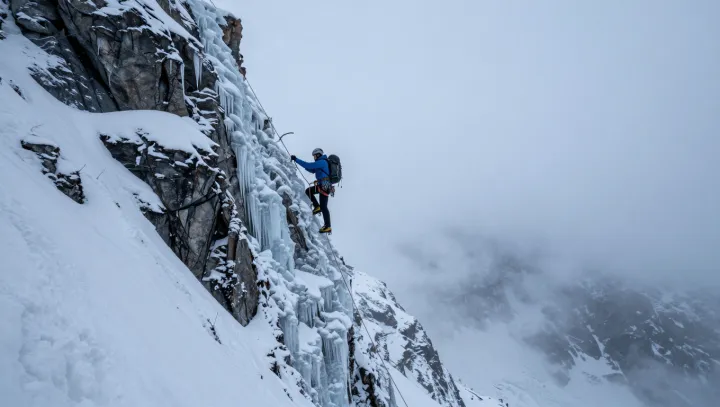
A sheer frozen wall is not neutral terrain; it is a brittle engineering material waiting to be edited by force. Where rock demands pre-existing holds, ice simply asks for enough pressure in a small enough area to create them on demand, and that is exactly what sharp crampons and ice tools deliver.
This sport works because physics is aggressively one-sided. Tiny steel points focus body weight into pressures that can exceed those under a car tire, so the ice surface locally fails in compression and shear, forming a micro-shelf or keyhole for each point. The process is not gentle. Each swing of an ice tool sends a stress wave through the frozen sheet; fracture mechanics decides whether a controlled cone-shaped cavity forms around the pick or a dangerous crack propagates away. Climbers learn to dial impact so that the pick bites just deep enough to anchor through mechanical interlock rather than brute excavation.
Grip then comes from friction and geometry, not from any mystical stickiness. Once a pick or crampon tooth is embedded, static friction between steel and frozen water, amplified by the inward angle of the points and the direction of load, resists peeling and pullout. A slight kick sets front points perpendicular to the surface, converting downward weight into normal force that boosts frictional resistance. Even the thin melt film that forms under pressure can help, as refreezing locks micro-irregularities together. What looks like blind trust in metal is really a moving negotiation with stress, contact area and failure thresholds.