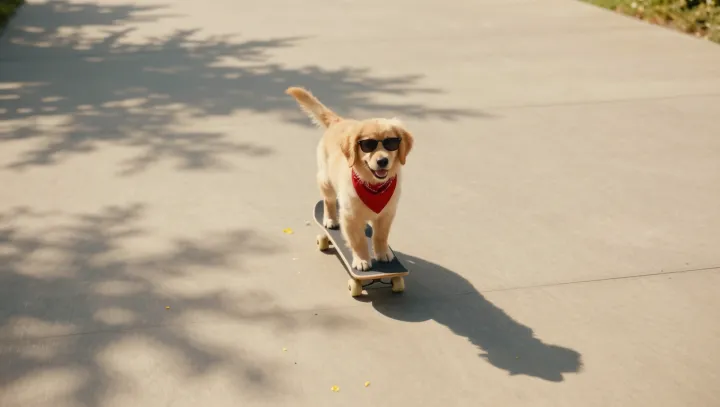
Balance, here, is not grace but brute computation. A rolling deck throws the golden retriever puppy off center; its brain answers with rapid-fire corrections, not style. Tiny shifts in paw pressure change the board’s rotation while the nervous system races to keep the center of mass above the wheels, and that tug-of-war, not elegance, is what keeps the animal upright.
The real workhorse is the cerebellum, that dense structure behind the brainstem that runs error correction like a high-speed control loop. Stretch receptors in muscles and mechanoreceptors in paw pads send constant data through sensory afferents; semicircular canals in the inner ear report head rotation. Those signals converge on cerebellar circuits, which compare expected motion to actual acceleration and fire off new motor commands through descending spinal tracts to tweak joint angles and muscle tone.
Clumsiness actually helps. Because the puppy overshoots and wobbles, synaptic plasticity kicks in; long-term potentiation and long-term depression in cerebellar pathways reweight connections with each slip. The skateboard acts like a moving lab bench, exaggerating instability and feeding the brain richer training data than flat ground ever could. Every near-fall updates the internal model of friction, wheel inertia, and body geometry, so the next micro-adjustment arrives a few milliseconds faster, just enough to keep four paws and rolling wood in reluctant harmony.