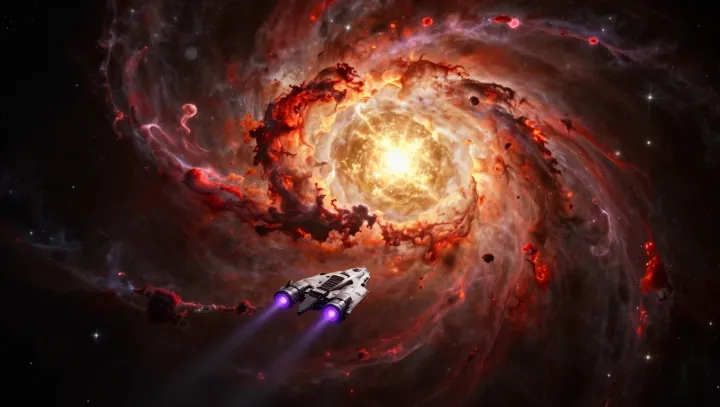
That blaze behind a deep‑space craft is not fire in any normal sense. Bright yes, but it owes nothing to air. The torch you see is energy leaving the vehicle as incandescent gas, radiation, and plasma racing away at extreme speed.
The odd truth is that rockets do not need air to burn; they carry both fuel and oxidizer, and the chemical reaction called combustion happens inside the chamber at enormous pressure, then vents into near‑vacuum where the hot mix expands violently and cools while still glowing. Those exhaust molecules, stripped and shaken, emit photons as they drop from excited electronic states, a process straight out of a spectroscopy textbook. In that huge pressure drop, shock diamonds form as standing pressure waves, and these structures further heat pockets of gas, which again radiate visible light. No oxygen outside, no problem inside.
Equally counterintuitive is how emptiness can make the plume look larger, not smaller. With so few ambient particles to collide with, the exhaust fans out freely, creating a wide, luminous cone instead of a tight, noisy flame. Ion thrusters push this logic further: their glow comes from ionization and recombination, not from any roaring blaze, yet the same electrodynamics and photon emission rules apply, turning thin streams of xenon into a visible thread of engineered starlight.